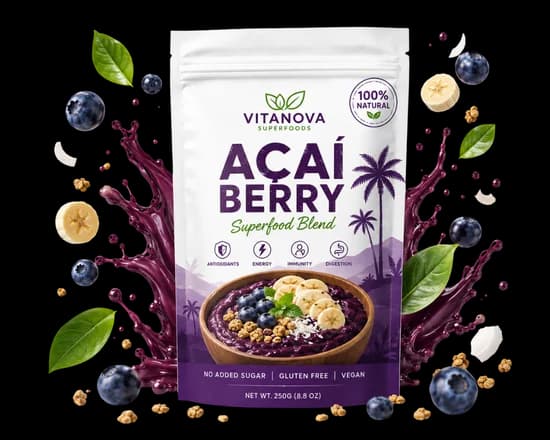
EU Regulation 1169/2011 on the provision of food information to consumers (FIC) applies to all food sold in the European Union, including online sales. If you're selling food in the Netherlands, Germany, Belgium, France, or any other EU member state, this regulation governs your packaging.
The 14 Mandatory Label Elements
Article 9 of FIC Regulation 1169/2011 requires the following on every food label:
- Name of the food, legal name, not just a trade name
- Ingredients list, in descending order of weight, as incorporated
- Allergens, highlighted in the ingredients list (bold, italic, or contrasting colour)
- Net quantity, in litres/millilitres for liquids, grams/kilograms for solids
- Minimum durability date, "best before" for most foods, "use by" for highly perishable
- Storage conditions, especially once opened
- Name and address, of the food business operator responsible
- Country of origin, mandatory for specific food categories (meat, honey, olive oil, fresh fruit/veg)
- Instructions for use, where necessary
- Alcohol content, for beverages over 1.2% ABV
- Nutrition declaration, per 100g/100ml, with 7 mandatory nutrients
- Lot marking, for traceability
- E-number additives, in the ingredients list
- Nanomaterials, must be labelled with [nano] after ingredient name
Allergen Rules
The 14 major allergens declared in EU Annex II must be emphasised in the ingredients list. Bold or a contrasting colour are the most common methods. These are:
Cereals containing gluten, crustaceans, eggs, fish, peanuts, soybeans, milk, nuts (including almonds, hazelnuts, walnuts, cashews, pecan, Brazil, pistachio, macadamia), celery, mustard, sesame, sulphur dioxide/sulphites (>10ppm), lupin, molluscs.
Minimum Font Size
Mandatory particulars must be in a minimum font size of 1.2mm x-height (0.9mm for packages with a largest surface area under 80cm²).
This has direct design implications, your designer must know these rules and apply them correctly.
Nutrition Declaration Format
The mandatory nutrients in the 'big 7' format:
- Energy (kJ and kcal)
- Fat / of which saturates
- Carbohydrates / of which sugars
- Protein
- Salt
Can optionally add: monounsaturates, polyunsaturates, polyols, starch, fibre, vitamins, minerals.
Language Requirements
Labels must be in the official language(s) of the member state(s) where the product is sold. In multilingual countries (Belgium: French/Dutch/German) all languages may be required.
This is critical for Netherlands (Dutch), Germany (German), France (French), Italy (Italian), and Spain (Spanish).
Post-Brexit: What Changed for UK?
The UK is no longer subject to EU FIC. UK rules (UK FIR) are largely identical post-transition but specific differences include:
- QUID (Quantitative Ingredient Declaration) rules remain
- UK requires a UK-based Food Business Operator address
- Some additive statuses differ
 Chat on WhatsApp