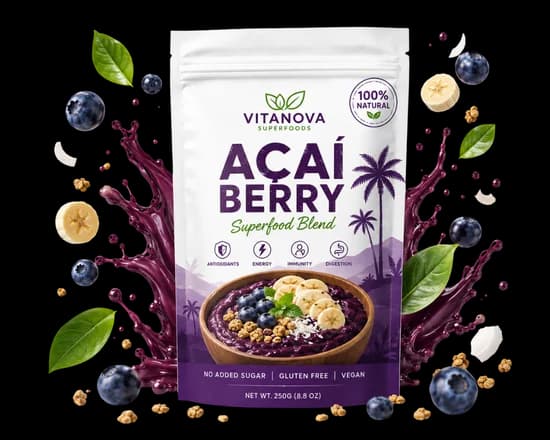
Germany's 84 million-person market, Europe's largest, spreads packaging and brand design demand across seven distinct hubs: Düsseldorf anchors the Rhine agency corridor and is home to Henkel (Persil, Schwarzkopf), functioning as Germany's de facto advertising and design capital; Hamburg, a historic publishing and port city, hosts Beiersdorf (Nivea) and a dense packaging-design cluster; Munich and Stuttgart drive premium automotive and engineering-brand work around BMW, Mercedes-Benz, Porsche and Bosch; Frankfurt and Cologne anchor the trade-fair economy (Messe Frankfurt, Kölnmesse) that regularly commissions exhibition and retail packaging. Germany's packaging industry generated roughly €30.5 billion in revenue in 2024, one of the largest national packaging markets in Europe, and the market's reputation for engineering precision extends to design expectations: EU FIC-format nutrition declaration tables (Nährwertkennzeichnung), the Green Dot (Grüner Punkt) recycling mark, and Nutri-Score front-of-pack labelling are all now baseline considerations for shelf-ready work.
Key Industries Driving Packaging Demand in Germany
Automotive (Volkswagen, BMW, Mercedes-Benz, Porsche, Bosch), pharmaceutical (Bayer, Merck, Boehringer Ingelheim), chemical and industrial (BASF), branded consumer goods (Henkel, Persil, Schwarzkopf; Beiersdorf, Nivea), machinery, and premium food and beer.
Packaging Regulations in Germany
EU FIC Regulation 1169/2011 sets the baseline; Germany's implementing ordinance, the Lebensmittelinformations-Durchführungsverordnung (LMIDV), last amended 24 November 2025, requires German-language labelling and layers on domestic rules, including mandatory ingredient lists on beer (a national requirement since 1994, since FIC exempts drinks above 1.2% ABV) and, since February 2024, mandatory origin labelling on non-prepackaged fresh, chilled and frozen pork, lamb, goat and poultry. Packaging producer responsibility runs through the Verpackungsgesetz (VerpackG), requiring registration in the LUCID packaging register administered by the Zentrale Stelle Verpackungsregister (ZSVR) and participation in a licensed dual system (Der Grüne Punkt and others) before filled retail packaging can be placed on the market, violations carry fines of up to €200,000 and can trigger sales bans. VerpackG is now being superseded: the EU Packaging and Packaging Waste Regulation (PPWR, Regulation (EU) 2025/40) applies directly across the EU from 12 August 2026, and Germany's Federal Cabinet adopted a draft Verpackungsrechts-Durchführungsgesetz (VerpackDG) on 11 February 2026 to implement it, bringing an EU-wide packaging recyclability grading system (A–E, only C-or-above permitted from 2030), a 40% maximum empty-space ratio for e-commerce packaging, and PFAS limits on food-contact packaging (25 ppb for any single substance, 250 ppb combined). BfArM (Bundesinstitut für Arzneimittel und Medizinprodukte) governs pharmaceutical packaging and patient information leaflets. The Bio-Siegel and EU Organic Logo require certified use. Nutri-Score front-of-pack labelling, voluntary since 2020 under LMIDV Article 4a with roughly 960 companies and 1,420 brands registered as of April 2025, underwent a formula revision on 1 January 2026 that has already prompted more than 30 manufacturers to withdraw the label from parts of their range, current registration status should be verified before laying out a Nutri-Score badge.
What Print-Ready Files Look Like for Germany Distribution
All Awais Khadim deliverables for Germany clients include:
- Dielines and cut files: Every structural format, labels, cartons, pouches, mailer boxes, includes the dieline or cut path alongside the artwork file.
- CMYK-configured artwork: Set up for offset, flexographic, or digital print as appropriate to the project and print supplier.
- Pantone specifications: Brand colours specified in both the Pantone C/U variant (for ink specification) and CMYK (for digital proofing and suppliers without Pantone capability).
- Print-ready PDF: PDF/X-1a or PDF/X-4, with all fonts embedded and bleed and crop marks correctly set.
- € pricing: All projects quoted in EUR, with clear scope and revision round specifications included.
- Language-compliant source files: Text layers are editable in the source files and configured for Germany's mandatory label language requirements, copy updates, new regulatory statements, or bilingual text additions can be made without rebuilding the design.
View packaging portfolio → | Start a project →
Working with Awais Khadim for Germany Brands
Our German-market portfolio includes work for Mol Analytic GmbH (elemental analyzer installation and quick-start documentation for the German industrial sector). All German deliverables are produced in German with EU FIC-compliant nutrition declaration formats and VerpackG-compliant packaging material specifications.
Awais Khadim has delivered packaging, label design, and brand identity for brands across the Germany market and the wider region. What this means practically:
- Regulation-aware files: Label requirements, mandatory declarations, and compliance-specific typography are built into the source file at brief stage, not retrofitted at the end.
- Print-ready output: All deliverables include dielines, CMYK-configured artwork, Pantone colour specifications, and PDF/X-1a or PDF/X-4 print-ready exports.
- € pricing and transparent quotes: All projects are quoted in EUR with clear scope, revision rounds, and file format specifications included.
- Service categories: Product packaging (food, supplements, cosmetics, e-commerce), label and sticker design, box and pouch packaging, brand identity systems.
View packaging portfolio → | Start a project →
Frequently Asked Questions
What EU food labeling rules apply in Germany?
Germany applies EU Food Information to Consumers Regulation 1169/2011 (EU FIC) as primary law. This requires a nutrition declaration, ingredient list with 14 allergens highlighted, net quantity, best-before or use-by date, country of origin for certain categories, and name and address of the EU food business operator. The label must be in German for goods sold in the German market, not English, not a general 'EU language'.
What is the German Packaging Act (VerpackG) and does it apply to me?
The German Packaging Act (Verpackungsgesetz / VerpackG, in force since January 2019) requires all companies placing packaged goods on the German market to register on the LUCID platform (Zentrale Stelle Verpackungsregister) and licence their packaging volume with a dual-system provider (Der Grüne Punkt, DSD, Reclay, or others). This applies to e-commerce imports too, non-EU sellers shipping directly to German consumers must register and licence their packaging materials or face fines and import blocks.
Are there specific language requirements for packaging sold in Germany?
Yes. EU FIC requires mandatory label information in the official language of the member state where food is sold, German for the German market. There is no exemption for English-only labels, even on premium international products. CLP Regulation (EC) 1272/2008 similarly requires safety and hazard labeling in German for chemical, cleaning, and cosmetic products. Optional marketing copy in English alongside German is commercially common but cannot replace the mandatory German text.
Content accurate as of July 2026. Regulatory requirements change, always verify current requirements with a qualified local compliance advisor before finalizing production files.



 Chat on WhatsApp